
Home / Patient education / Invisalign or braces
Invisalign or braces: how to choose
Short answer: both Invisalign clear aligners and braces can straighten teeth and improve a bite. Invisalign suits many mild to moderate cases when the aligners are worn twenty to twenty-two hours a day, while braces stay fixed in place and are often the more predictable choice for complex tooth movement or when daily wear would be hard to keep up. An examination with digital scans is the way to know which option fits your teeth.
Updated November 2026
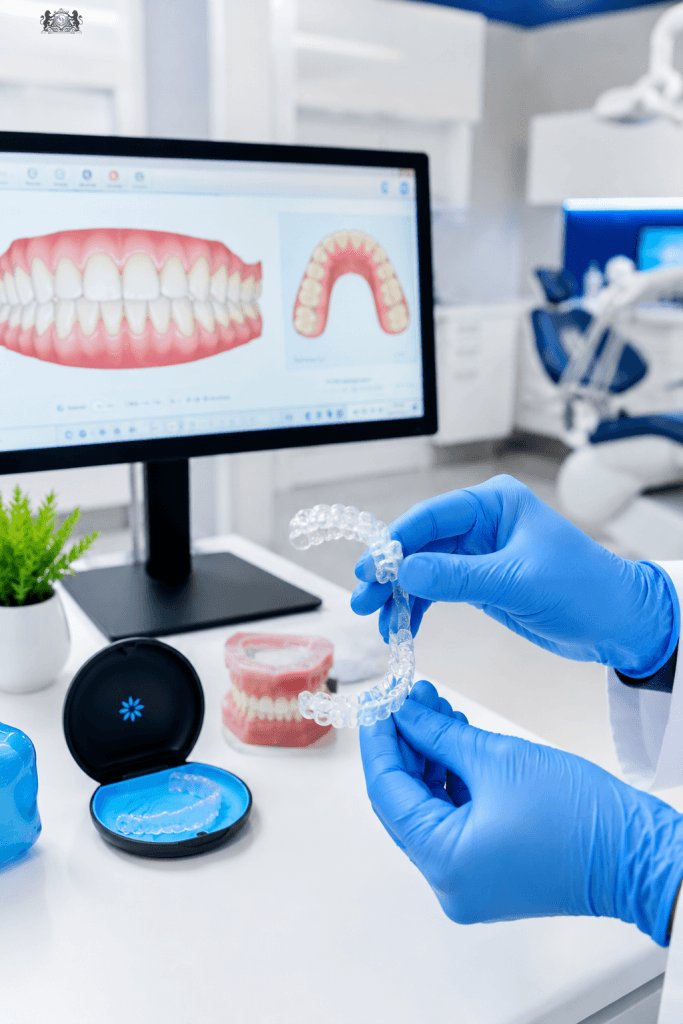
How the two compare
Both options move teeth with gentle, steady pressure over time. The main differences are in daily life: what other people see, what you eat and how much the result depends on your own routine.
| Invisalign | Braces | |
|---|---|---|
| How it works | A series of clear, removable aligners, each worn for about one to two weeks | Brackets bonded to the teeth, joined by a wire that is adjusted over time |
| Appearance | Clear and hard to notice | Visible, with metal or clear (tooth-coloured) brackets |
| Daily wear | Twenty to twenty-two hours a day; out only to eat and to clean your teeth | Always in place, so there is nothing to remember |
| Eating | Take the aligners out to eat, then brush before putting them back | Avoid hard and sticky foods that can loosen a bracket |
| Cleaning | Brush and floss as usual, and rinse and clean the aligners | Cleaning around brackets and wires takes more time |
| Visits | Progress visits to check the fit and collect new aligners | Visits every few weeks to adjust the wires |
| Typical length | About six to eighteen months for most cases | Often eighteen to twenty-four months |
| Afterward | A retainer to hold the result | A retainer to hold the result |
Which way it often leans
- Invisalign is often a good fit for mild to moderate crowding or spacing, for adults who prefer a discreet option, and for people confident they will wear aligners most of the day and night.
- Braces are often the better choice for larger bite corrections or more complex tooth movement, and for patients who would find it hard to keep removable aligners in.
- Either may work for many common cases. Your dentist will explain the trade-offs for your teeth before you decide.
Choosing for your stage of life
The better choice depends as much on routine and lifestyle as on the teeth themselves.
For teenagers
Aligners only work while they are worn, so the honest question for a teenager is whether they will keep them in for most of the day and night, including at school. Braces remove that question because they stay in place. Teens who play contact sports should wear a mouthguard with either option; aligners are usually taken out and a mouthguard worn instead.
For adults
Healthy teeth can be moved at any age, and many adults choose Invisalign because it is discreet and comes out for meals. Others choose clear braces when their case calls for more control. Gums need to be healthy before treatment starts, so we check for and treat any gum disease first.
Royal Oak Dental’s dentists are general dentists who provide Invisalign and braces. When a case is better treated by a certified orthodontist, we explain why and arrange a referral.
Questions about aligners and braces
Sometimes. Many Invisalign cases finish in about six to eighteen months, while braces are often worn for eighteen to twenty-four months, but the length depends far more on how much your teeth need to move than on the method. Aligners also stay on schedule only when they are worn as directed.
The cost of either option depends mainly on how complex the case is and how long treatment lasts. We give you a written estimate before you start and help you check your coverage.
Many plans contribute to orthodontic treatment, often up to a lifetime maximum. We submit claims directly to most plans and can help you check your coverage before treatment begins.
Yes. Teeth tend to drift after any orthodontic treatment, so a retainer is part of both options. We explain how often to wear it and how to care for it.
Most people feel light pressure or tenderness for a day or two when they start a new aligner or after a braces adjustment. It usually settles quickly, and soft foods help in the meantime.
Yes. Healthy teeth can be moved at any age. We check your teeth and gums first so treatment starts on a healthy foundation.
Sources: Canadian Dental Association – Orthodontics; Canadian Association of Orthodontists – Braces. This guide is general information and does not replace an examination.
Find out which fits you
Consultations with digital scans · Direct insurance billing · 584 Ford Drive, Oakville